How can landscapes better respond to climate change? This was one of the key questions explored by partners of the international LAND4CLIMATE project, who gathered for a consortium meeting in Košice and the Tokaj region from 9–11 March 2026. The event was hosted by the Agency for the Support of Regional Development Košice (ARR).
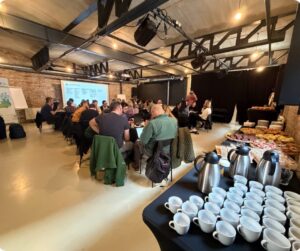
LAND4CLIMATE project partner meetings are not only about presentations and work programmes. They create a space where research, practice, and collaboration come together. The meeting in eastern Slovakia therefore combined expert discussions, field visits to the landscape, and an exchange of experiences among project partners.
Day 1: Arrival of Partners and Visit to the Tokaj Region
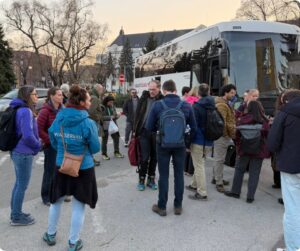
On the first day, project partners met in Košice and later in the afternoon travelled to the Tokaj region. The journey from the city to a landscape of vineyards and rolling hills symbolically marked the transition to an environment shaped by centuries of agricultural tradition. The evening continued with a shared dinner and a visit to a wine cellar located on the land of one of the landowners involved in the LAND4CLIMATE project. It is on these plots that nature-based solutions will be implemented to help address the risks of drought and flash floods in the vineyard. The vineyard landscape also served as a reminder of how closely land use, climate risks, and regional identity are interconnected.
Day 2: Observation and Learning Directly in the Field
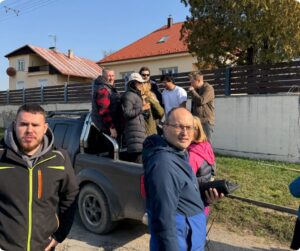
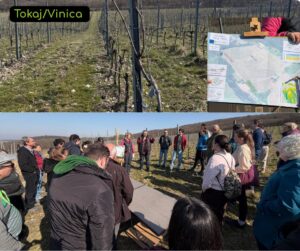
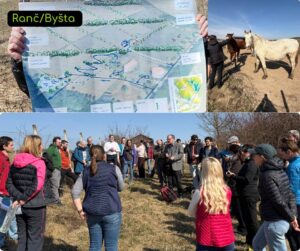
On the second day, the programme began with a field visit to sites planned for nature-based solutions (NbS) in the Zemplín region. Walking through vineyards, a ranch, and the rural landscape provided a hands-on perspective on the issues addressed by the LAND4CLIMATE project. Seeing the land directly and being guided by its caretakers—rather than only through data such as water runoff simulations, rainfall, maps, or presentations—helped bring the research questions to life. The excursion gave participants direct insight into the planned implementation of NbS across three locations.
MEASURES IN THE VINEYARD
Measures on the Ranch
Future Eco-Centre
At the planned eco-centre with an educational focus, the measures concentrate on:
-
creating terraced terrain for a fruit orchard,
-
establishing rain gardens,
-
planting windbreaks,
-
collecting water through on-site channels,
-
harvesting rainwater from the roof.
The main goal is water retention and soil protection.
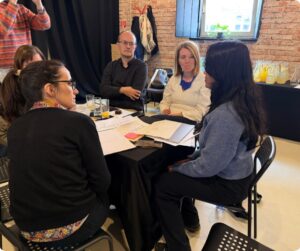
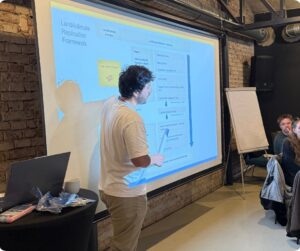
After the excursion, the partners returned to Košice for the formal sessions. The afternoon opened with welcome remarks, during which participants also discussed the progress achieved by the LAND4CLIMATE project. Discussions led by partners ICLEI and TUDO focused on one of the project’s main goals: how to replicate successful local climate solutions in other regions. Later, a simulation game led by partner UJEP allowed participants to explore land-use decision-making and climate adaptation in a playful, interactive way. Role-playing scenarios highlighted the complexity of regional planning and suggested possibilities for innovative solutions in the future. The day concluded with a guided walk through the historic centre of Košice, adding a cultural dimension to the meeting.
Day 3: Dialogue, Reflection, and Next Steps
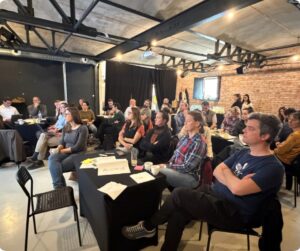
On the final day, the programme opened with a welcome from Barbora Kováčová, Head of the Regional Development Department of the Košice Self-Governing Region. The agenda focused on parallel sessions, allowing different groups within the consortium to delve deeper into their topics—from practitioners implementing NbS and replication regions to academic discussions and exchanges for PhD students. Partners from DEN and project managers from ARR facilitated discussions between practitioners and replicating regions. These sessions provided a safe and open space for sharing experiences and challenges, including issues related to permits, sustainability, and the difficulties faced by replication regions. A general presentation on the Roňava river basin illustrated how climate and water challenges intersect with regional planning. The consortium concluded the day by reviewing next steps and aligning plans for the future. These discussions are often the most valuable moments of the meeting, offering an opportunity to pause, address open questions, and plan the path ahead.
More Than Just a Meeting
What stood out most during these days was the sense of shared purpose. Projects like LAND4CLIMATE rely on collaboration across countries, disciplines, and institutions. Meetings like this strengthen those connections and remind us why this work is so important.
This article was produced in collaboration with Sara Giorgi from the DEN Institute.